Embedded finance in the Middle East and North Africa region is picking up steam and growing at double-digit rates. Banks and financial institutions are weaving payments, loans, insurance, and other core financial services into apps and platforms outside their own channels. While it has been on the radar globally for several years, Embedded Finance is taking hold in MENA with strong momentum. Market research indicates the region’s embedded finance market is expected to grow by around 45% by 2030, a pace more than twice the global average, driven by rapid platform adoption, regulatory progress, and unmet demand for contextual financial services.
Embedded Finance Market Growth in MENA
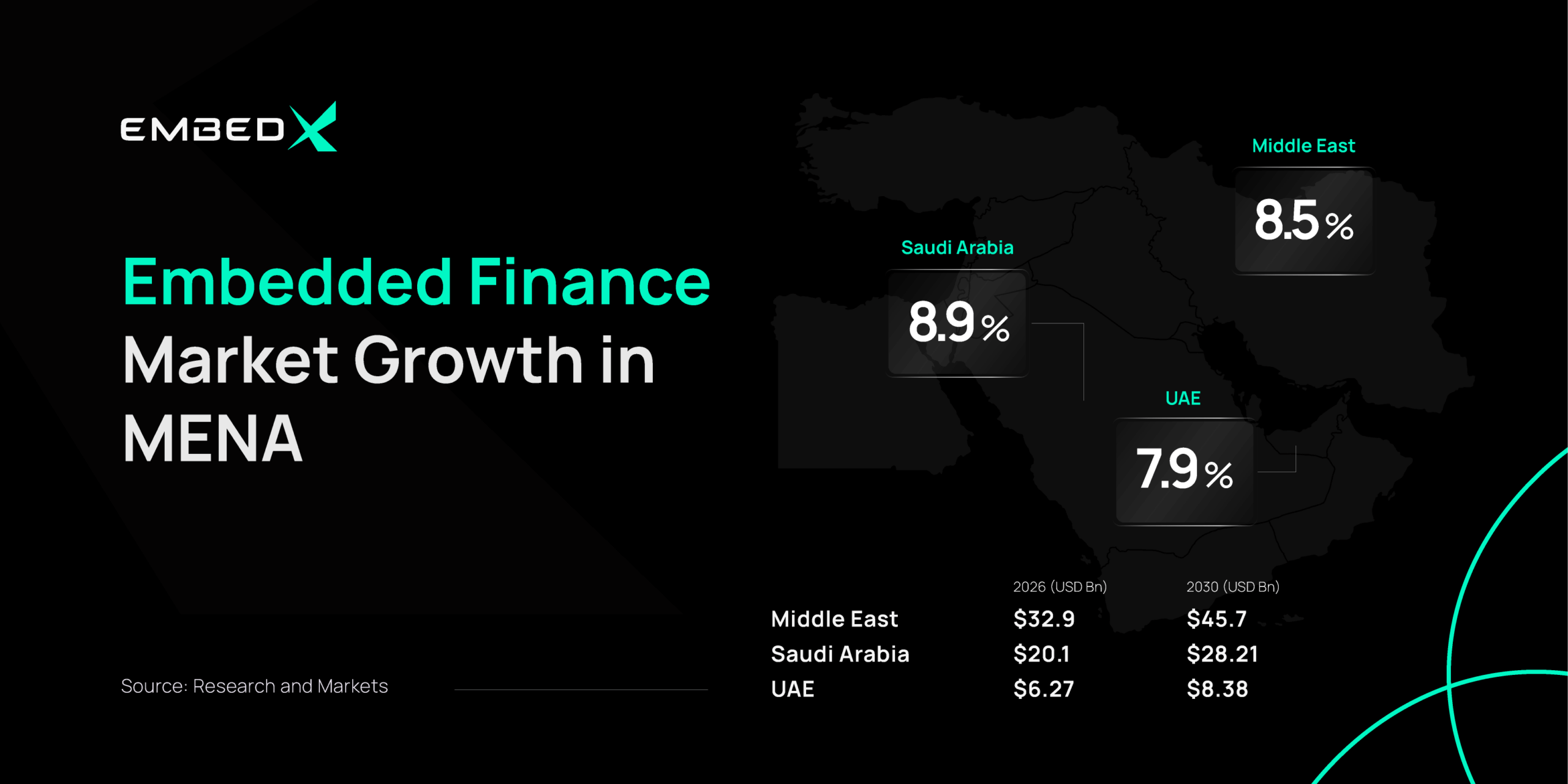
Embedded finance has become a multi-billion-dollar engine for the MENA economy. Statistics show that the Middle East market alone is projected to grow from $32.9 billion in 2026 to $45.7 billion by 2030, reflecting a compound annual growth rate of 8.5 percent as embedded models scale across the region.
The UAE and Saudi Arabia are among the key growth markets shaping this expansion. Saudi Arabia represents the largest share, with the embedded finance market expected to grow from $20.1 billion in 2026 to $28.21 billion by 2030, at a CAGR of 8.9 percent. The UAE follows with steady growth, expanding from $6.27 billion in 2026 to $8.38 billion by 2030, growing at a 7.5 percent CAGR.
Other countries such as Bahrain, Qatar, and Egypt are also showing significant progress with the integration of financial services into digital ecosystems. While smaller in absolute market size, these markets are recording consistent expansion, reflecting broader adoption of embedded finance across the region.
Why Embedded Finance is Gaining Traction in MENA
The region’s embedded finance growth stems from a convergence of market readiness and opportunity. Digital adoption, platform expansion, and evolving financial ecosystems are creating fertile ground for financial services to reach customers in new ways. Demand for more seamless, integrated experiences is increasing, while the market itself is maturing beyond experimentation. Some of the leading drivers shaping this momentum include:
- Surge in Digital Adoption: MENA’s high digital penetration is accelerating embedded finance adoption. Smartphone usage exceeds 76% and internet penetration stands at 67%, creating always-connected consumer behavior. Network quality is also advancing rapidly, with Qatar and UAE leading the world in mobile internet speeds.
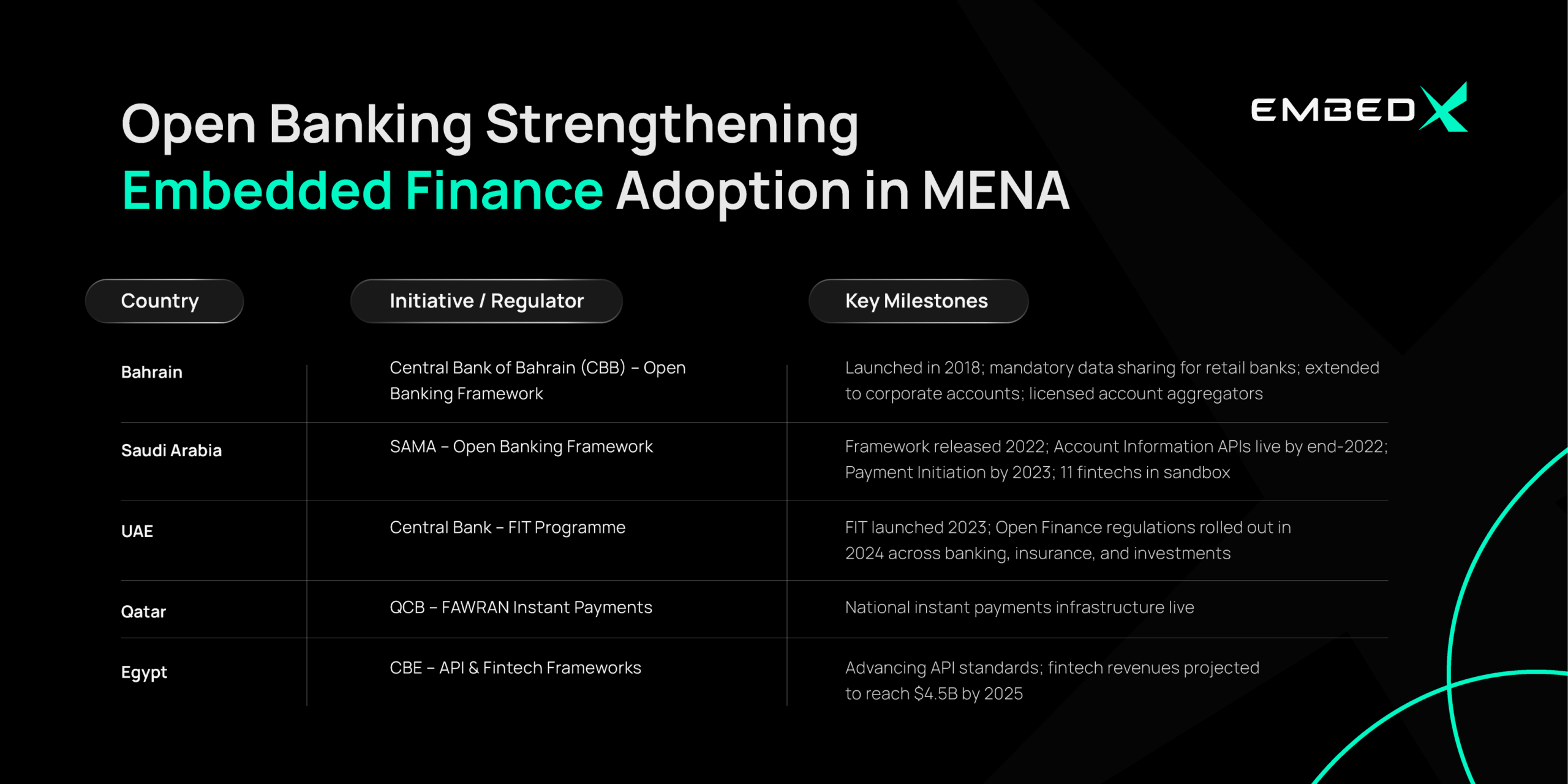
- Advancing Open Banking Initiatives: Progressive open banking regulations across MENA are enabling embedded finance at scale. Bahrain, Saudi Arabia, and the UAE have introduced mandatory frameworks, while parallel initiatives in Qatar and Egypt are further strengthening regional infrastructure, positioning open finance as a foundational growth enabler.
- E-commerce Explosion: The rapid expansion of e-commerce is creating a natural distribution layer for embedded finance across MENA. The market reached $34.5 billion in 2024, growing 13% year-on-year, and is projected to climb to $57.8 billion by 2029. As digital commerce scales, demand for embedded payments, credit, and post-purchase finance is accelerating alongside it.
- Growing SME and Gig Economy Activity: Small businesses and independent workers are expanding rapidly across MENA, with freelance registrations up 142% in 2023. SMEs face persistent gaps in financial access, and embedding financial services such as credit, invoice financing, and payments directly into platforms is helping them operate and grow more efficiently.
- Telco-Led Innovation: Telecom operators across MENA are increasingly offering digital wallets, micro-lending, and payment services within their existing mobile ecosystems. Leveraging extensive customer bases and robust mobile infrastructure is enabling them to embed financial services to reach consumers in contexts where traditional banking has limited presence.
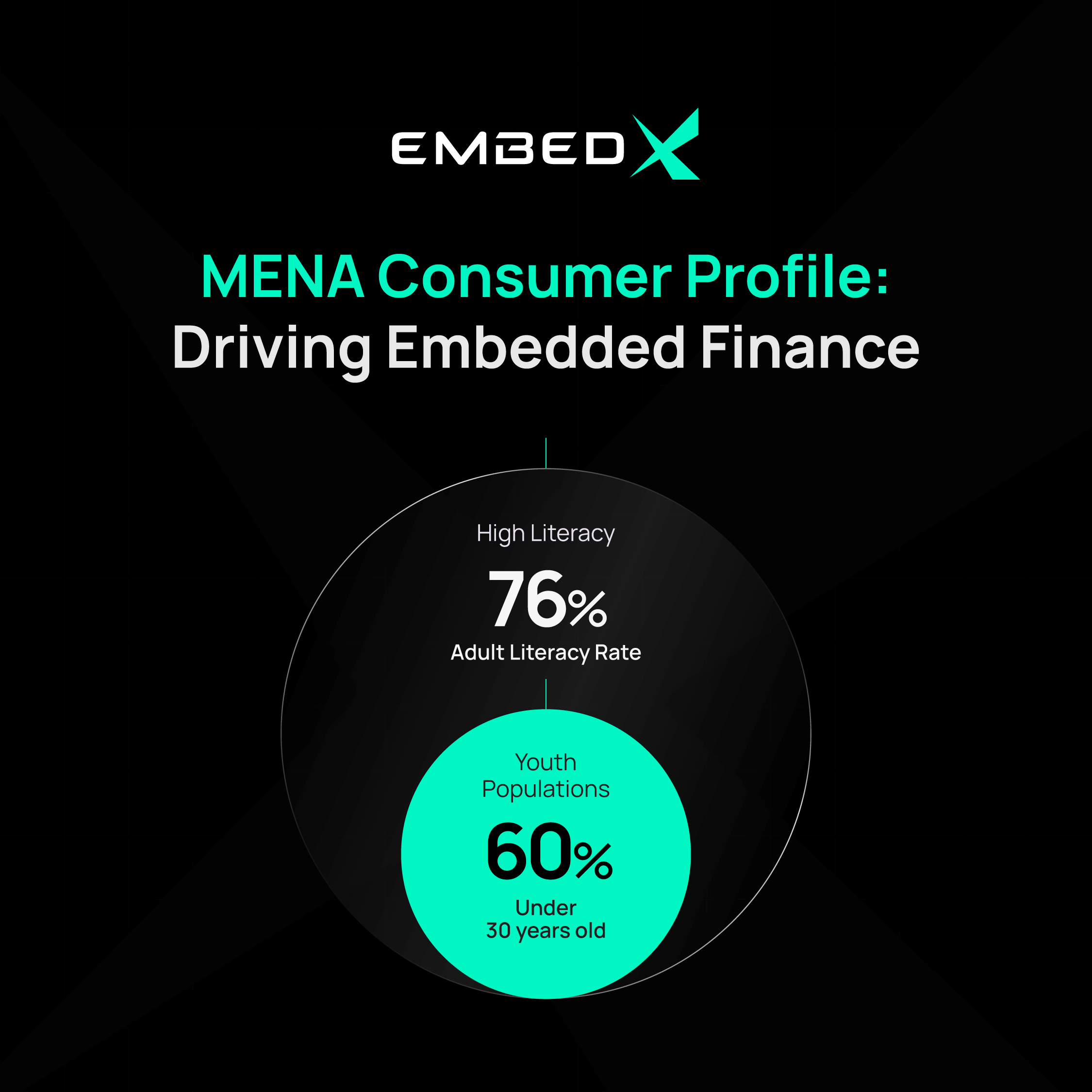
- Consumer Preference for Seamlessness: MENA has one of the youngest populations globally, second only to Sub-Saharan Africa, with over 60% under the age of 30. Coupled with an adult literacy rate of around 76%, this digitally savvy demographic expects fast, integrated financial services that fit seamlessly into their daily digital interactions.
High-Impact Embedded Finance Solutions
The potential of embedded finance lies in its ability to transform how financial services are delivered and consumed. Across MENA, platforms and institutions are seeking solutions that integrate seamlessly into digital journeys, creating real value for end users. These include:
- Embedded Payments: Seamlessly integrate payment capabilities directly into platforms for frictionless transactions.
- Embedded Credit and Financing: Contextual access to credit, BNPL, and invoice financing for consumers and SMEs.
- Embedded Wallets: Digital wallets that manage funds, payments, and banking services within existing platforms.
- Embedded Insurance: Micro-insurance and protection integrated into user journeys at the point of need.
- Embedded Rewards and Loyalty Programs: Integrated incentives, cashback, and rewards to drive engagement.
- Embedded Earned Wage Access: Instant access to earned wages for employees or gig workers, supporting financial flexibility.
- Embedded Investments and Savings: Allow users to invest or save seamlessly within the platforms they already use.
- Embedded Remittances and Cross-Border Payments: Fast, low-cost money transfers integrated into digital ecosystems.
- Embedded Subscription Management and Billing: Automate recurring payments for services directly in-app.
Tangible Benefits for Platforms and Institutions
Integrating finance into the platforms and ecosystems customers already live creates immense business value to both the financial institutions and platforms.
- Expanded Revenue Streams: Embedding financial services unlocks multiple monetization avenues, including transaction fees, lending interest, insurance premiums, and recurring service charges, turning existing digital platforms into full-fledged financial ecosystems.
- Increased Customer Retention: Seamless, integrated financial experiences deepen engagement and loyalty, reducing churn by keeping users within the platform for a wider range of daily activities and transactions.
- Enhanced Data Insights: Access to transactional and behavioral data through embedded services allows platforms to better understand user needs, personalize offerings, and optimize risk management and product design.
- Accelerated Market Reach: Platforms can rapidly extend financial services to existing audiences and underserved customer segments without investing heavily in standalone banking infrastructure or building new customer bases from scratch.
- Operational Efficiency: Embedded finance simplifies complex workflows, reduces reliance on third-party providers, and streamlines service delivery, allowing institutions to scale offerings with lower operational overhead.
- Competitive Differentiation: Offering contextual and integrated financial services strengthens market positioning, signaling innovation and customer-centricity in a crowded and rapidly evolving digital ecosystem.
- Regulatory Alignment and Compliance Leverage: Embedding finance through compliant frameworks ensures that platforms can expand their offerings with reduced regulatory risk, while maintaining trust and credibility among users.
Final Thoughts
The wave of embedded financial services is sweeping through the commercial landscape of MENA and redefining competitive dynamics. The strategic question has now moved from ‘if’ to ‘how’ they will integrate these capabilities. The most effective approach begins with a clear use case. Identify a specific customer pain point within your existing journey where a financial product provides a natural solution.
The decision to build, buy, or partner is critical. For most, partnering with a specialized provider like EmbedX through APIs offers the fastest path to market. It leverages existing regulatory and technological infrastructure, allowing you to concentrate on your core customer experience. Ultimately, long-term success depends on viewing embedded finance not as a feature, but as a continuous strategy for service delivery and business growth.