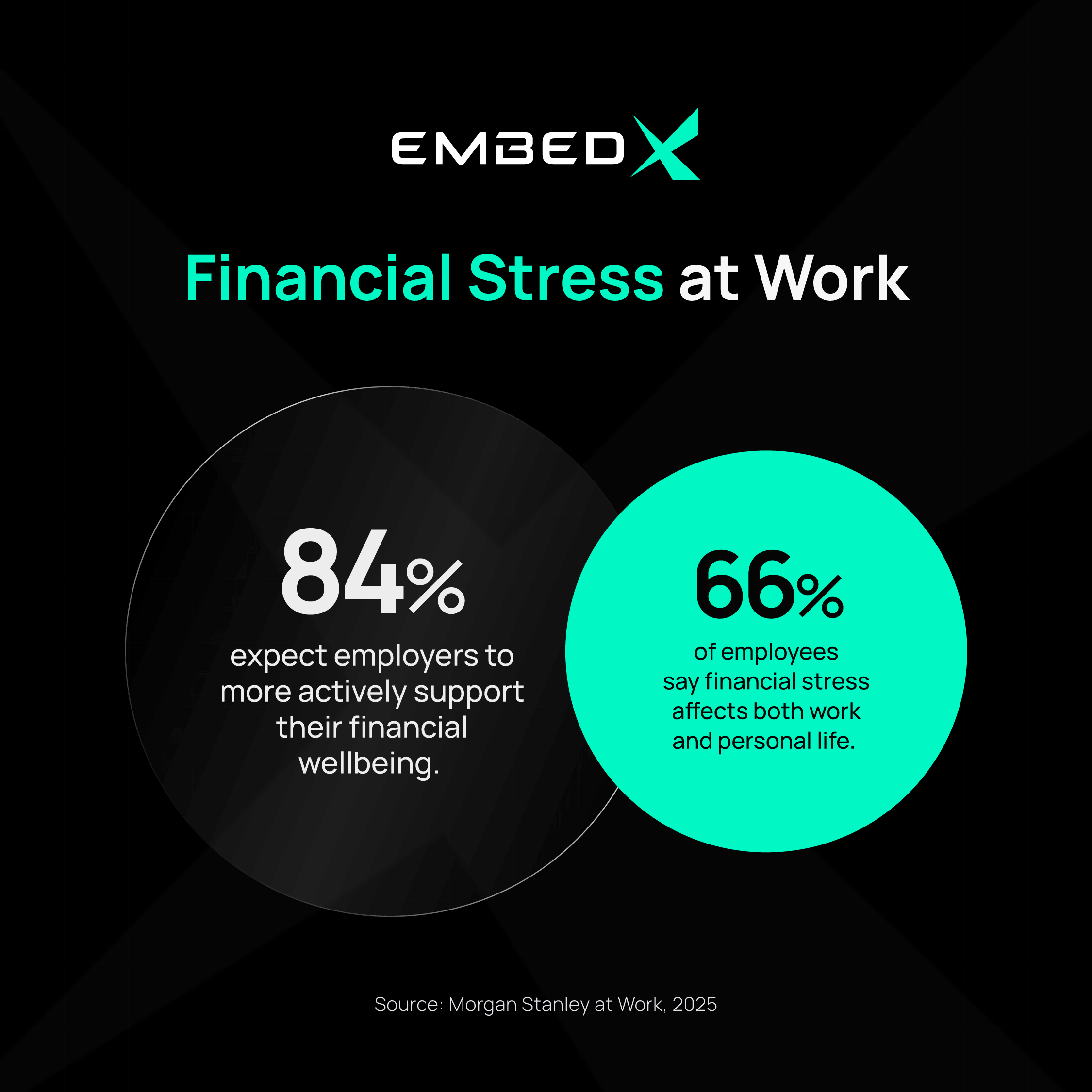
Money stress is the number one source of stress and anxiety for employees globally, outranking work pressure, health concerns, and family issues. According to Morgan Stanley’s State of the Workplace 2025 survey, 66% of employees say financial stress negatively affects both their work and personal lives – a 4% increase from 2024. The study also highlights that 84% of employees expect their employers to more actively support them in managing their financial issues.
Part of the challenge comes from traditional pay cycle structure. Most employees are still paid monthly or biweekly, a schedule that works for organizations but doesn’t always match how financial needs arise. A broken car, a medical bill, a missed rent payment, none of these wait for payday. Workers stuck in this system often resort to payday loans, overdrafts, or high-interest credit lines to stay afloat.
For employers, this is a business problem. Financially stressed workers are less focused, more likely to leave, and harder to retain. This is why Earned Wage Access (EWA) has emerged as a solution many organizations are now exploring.
What is Earned Wage Access?
Earned Wage Access (EWA) allows employees to access a portion of the wages they have already earned before their scheduled payday. Unlike a loan, there are no interest charges or hidden fees. Employees simply draw on funds they have already worked for, giving them the flexibility to cover unexpected expenses or manage cash flow between pay cycles. EWA is typically integrated directly into payroll and HR systems so employees can request and receive funds quickly and securely, often in real time, without any manual processing or paperwork.
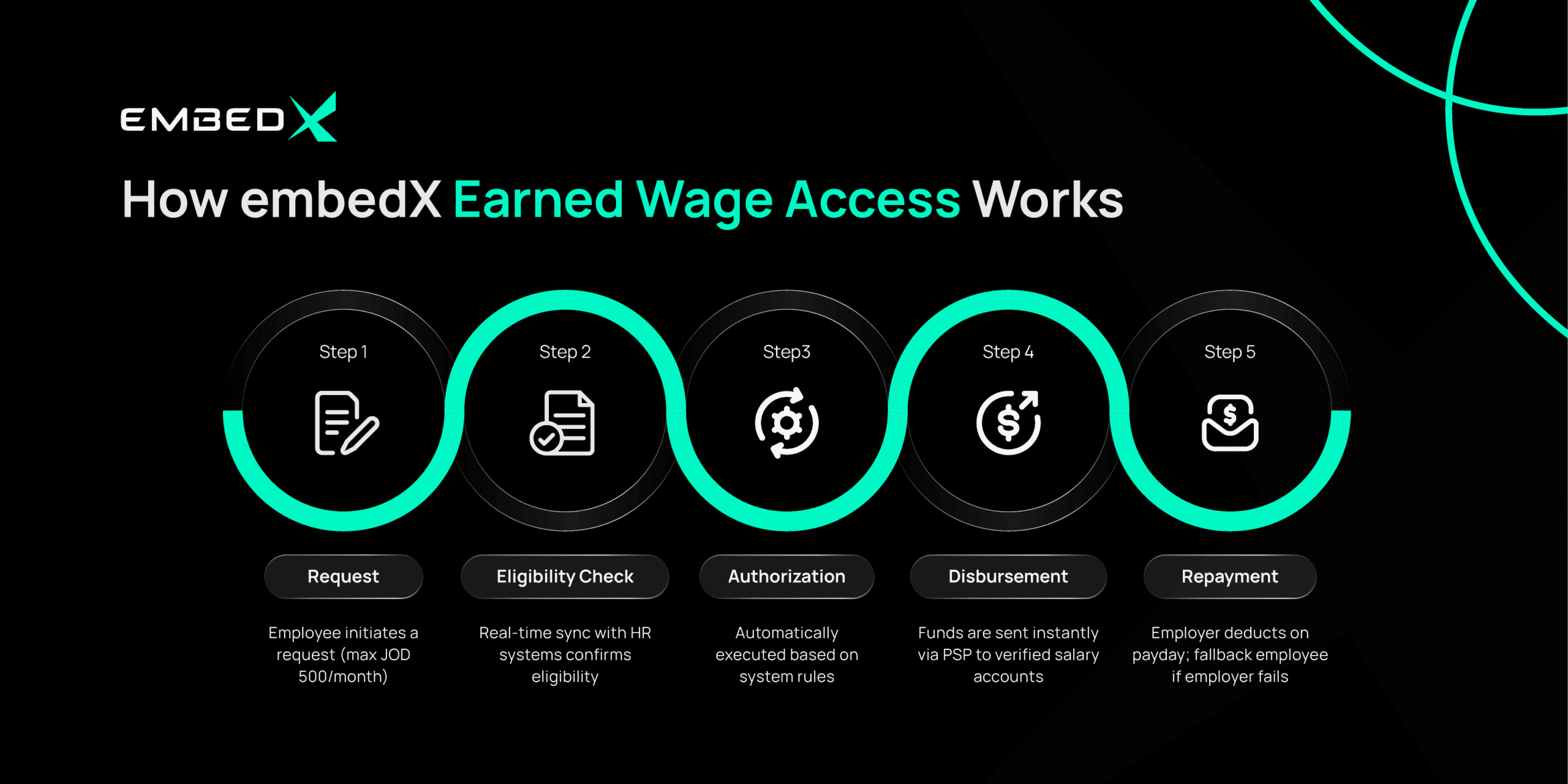
This can be illustrated using our embedX Earned Wage Access solution. The process, from initiation to disbursement, takes less than 15 seconds and involves the following steps:
- Request: The employee initiates a request for early access to earned wages.
- Eligibility check: The system performs a real-time eligibility check using integrated HR data.
- Authorization: The request is automatically approved based on preset rules.
- Disbursement: Funds are instantly transferred to the employee’s verified salary account via a licensed Payment Service Provider (PSP).
- Repayment: The funds are automatically deducted from the employee’s salary on payday. If the deduction fails, the employee is responsible for repayment under the agreed terms.
Why EWA Matters for Employee Financial Wellbeing
Employees today are just as concerned with their financial wellbeing as they are with their physical and mental health. With the cost of living rising and financial pressures mounting, how and when employees are paid has become an important conversation for employers. Allowing employees to access their earned wages before payday offers many benefits. A 2025 study by the International Labour Organization and the Global Centre on Digital Wages for Decent Work highlights:
- Stronger financial control and stability
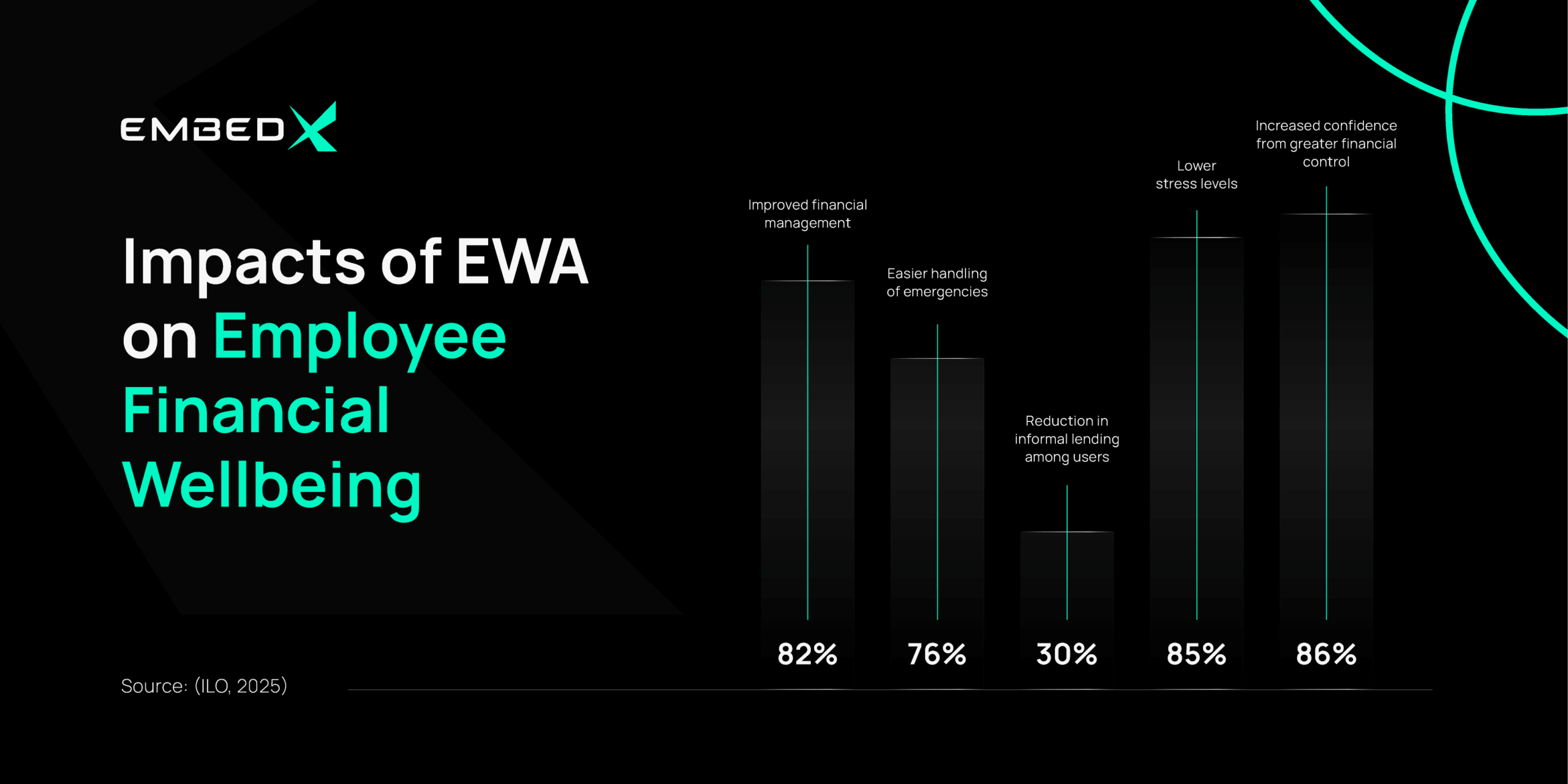
EWA helps employees better manage day-to-day finances and unexpected expenses. 82% of users report improved financial management, while 76% say it is easier to handle emergencies, supporting greater financial resilience and independence.
- A safer alternative to high-cost credit
EWA reduces reliance on payday loans and informal borrowing, with studies showing up to a 30% reduction in informal lending among users.
- Lower financial stress and improved confidence
Access to earned wages reduces financial anxiety. Between 52% and 85% of users report lower stress levels, while up to 86% say their confidence has improved due to greater financial control and independence.
- Fast, convenient access to funds
Timely access is critical during financial need. Between 87% and 99% of users rate EWA’s speed positively, with many able to access funds within minutes, aligning income access with real-life financial demands.
The Strategic Business Value of EWA to Employers
From an employer’s perspective, EWA directly impacts the business bottom line. Companies offering Earned Wage Access report significant benefits in productivity, retention, and employee loyalty, which are all indicators of strong operational performance.
- Stronger Employee Retention
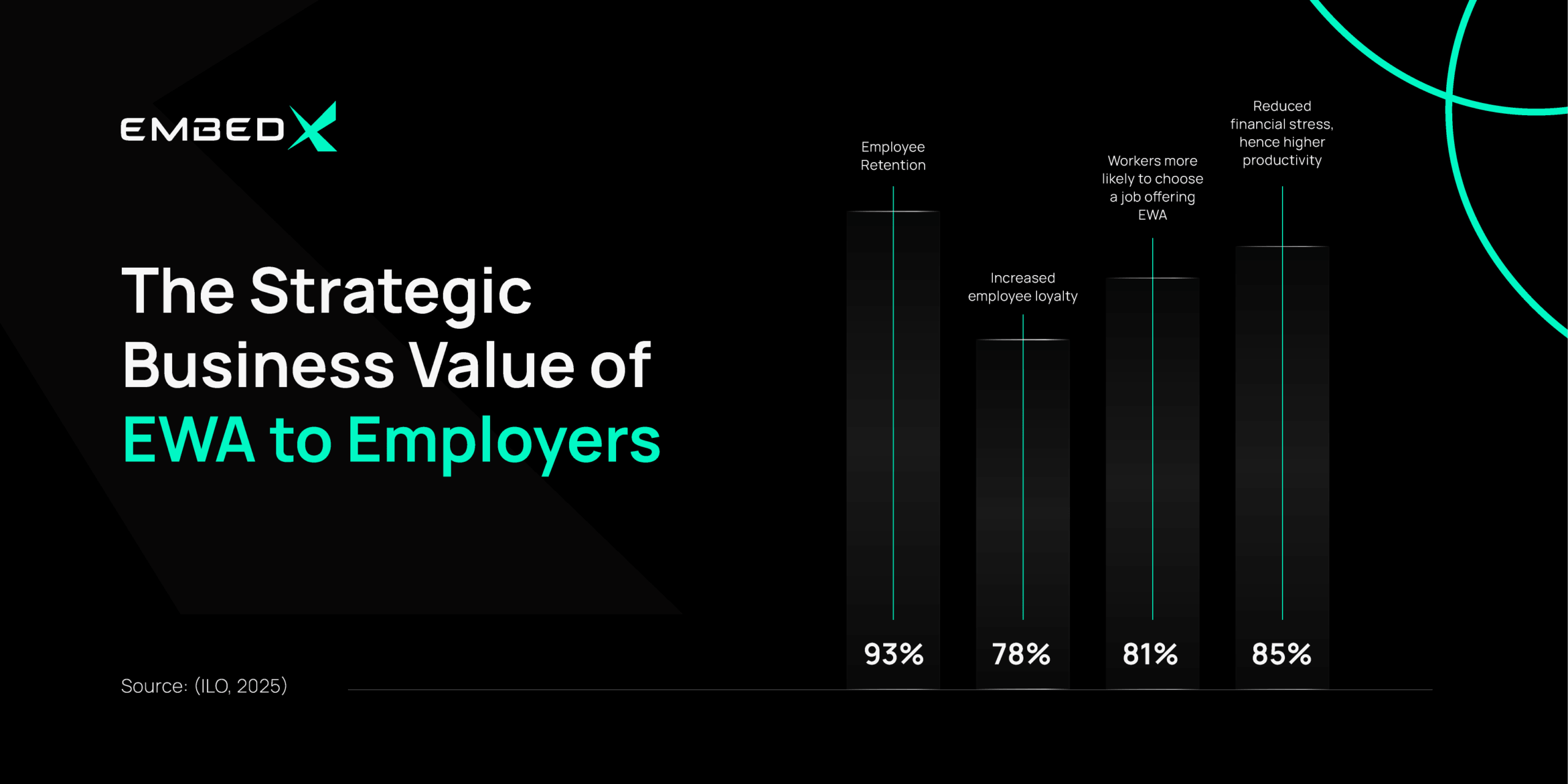
93% of employers offering EWA report that it has actively helped them retain staff. Given that replacing a single employee can cost anywhere from 50% to 200% of their annual salary, EWA drives significant operational and financial impact.
- Greater loyalty and engagement
78% of workers say that access to earned finances increases their loyalty to their employer. Loyalty translates to discretionary effort – employees who feel supported are more likely to go above and beyond, stay longer, and advocate for the company.
- A decisive factor in talent acquisition
Research shows 81% of workers would take a job offering EWA over one that doesn’t. In competitive hiring markets, this gives employers a concrete differentiator that doesn’t require raising base salaries.
- Measurable wellbeing outcomes
Up to 85% of EWA users report lower financial stress. A less stressed workforce is a more focused, present, and productive one — with direct implications for output quality and workplace culture.
In addition, EWA gives organizations a strong ESG advantage. Under the ‘S’ (Social) pillar of Environmental, Social, and Governance frameworks, financial inclusion and employee welfare are increasingly monitored by investors and regulators. Offering EWA is a concrete, measurable action that signals a company genuinely prioritizes financial equity.
The Embedded Finance Infrastructure Behind EWA Solutions
For Earned Wage Access solutions to work at scale, they need to plug into the systems that already govern how employees are paid and managed. That means deep integration with Human Capital Management (HCM) platforms, which hold verified employee data that the system needs to confirm eligibility in real time. The systems also require direct connections to payroll engines so repayments are deducted automatically at the source on payday, without any manual intervention. Beyond HR and payroll, EWA systems are also integrated with Payment Service Providers (PSPs) to move funds instantly to verified salary accounts, as well as with compliance and credit bureau infrastructure to handle risk controls, consent logs, and secondary repayment enforcement when needed.
This is exactly what our embedX EWA solution delivers. Built on Codebase Technologies’ cloud-native, API-first Digibanc engine, embedX connects financial institutions and non-bank platforms through a single, secure integration layer. It integrates directly with HCM platforms to pull real-time employee data such as tenure, salary, and employment status, then links to licensed PSPs for instant fund disbursement, and automates the full repayment cycle through payroll deduction. The platform also maintains immutable logs of consent and authorization at every step, keeping the process audit-ready and compliant.
As an embedded finance product built using a modular, composable architecture, it is easy to integrate on any employer platform and enables them to scale their EWA services quickly across multiple geographies and workforce types. New features, integrations, or compliance updates can be deployed without disrupting existing operations, ensuring a seamless, secure, and future-ready solution that adapts to evolving business and regulatory requirements.
A Low-risk Model with Strong Returns
For employers, the risk profile of the Earned Wage Access model is structured to be minimal. Repayment is tied directly to the payroll cycle – the primary deduction happens at the employer level, where the amount accessed is automatically deducted from the employee’s salary on payday. If that fails, a fallback mechanism is triggered, meaning the employee becomes directly responsible for repaying the amount under agreed terms, with enforcement supported through the credit bureau. This dual-layer structure keeps default exposure very low.
Our EWA solution uses this model and as a result, the projected default rate remains below 1%, which is significantly lower than most traditional lending products. Beyond risk mitigation, embedX is designed for efficient capital utilization and predictable returns. Because EWA transactions are short-term (typically 10–15 days) and repayments are automated, capital can be recycled multiple times within a year. This means the same pool of capital is not locked into long-term loans but is continuously redeployed, generating steady, repeatable returns.
For investors providing the credit line, the return model is fee-based – not interest-based, positioning it well in markets with Islamic finance considerations. Combined with short tenors and high capital rotation, this enables consistent yield generation and efficient deployment of capital. The economics look like this:
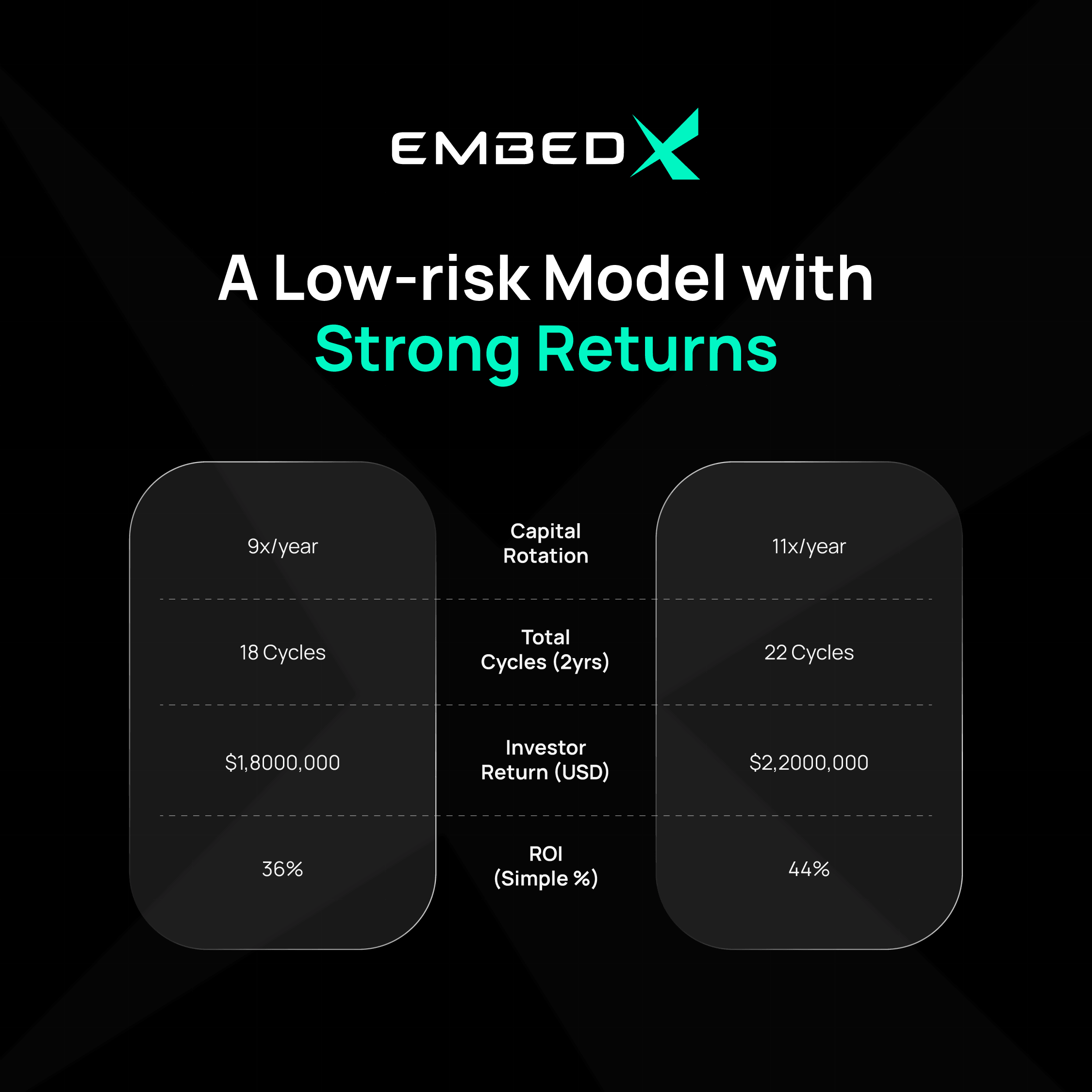
For employers, the benefit is effectively zero-cost. There is no capital outlay, meaning employers do not need to commit any upfront funds or allocate budget to offer the service. Also, the platform runs on partner infrastructure, and the fee is charged to the transaction, not the employer’s P&L. The gains are in retention, productivity, and workforce stability.
Strategic Use Cases Across Industries
EWA is not limited to one type of worker or business. The financial stress problem is sector-agnostic, and so is the solution. Some of the sectors where the model can have an immediate impact include:
- Manufacturing and blue-collar: Workers in shift-based roles often face cash gaps mid-cycle. EWA reduces absenteeism tied to financial pressure, which is especially prevalent across Africa and MENA.
- Healthcare: Nursing staff, care workers, and support roles frequently deal with irregular hours and unexpected costs. EWA gives them flexibility without requiring loans or advances from employers.
- Retail and hospitality: High-turnover sectors where even modest retention improvements translate into major cost savings. Offering EWA as a benefit differentiates the employer without raising base pay.
- SMEs: Smaller businesses can offer a benefit previously accessible only to large corporates, closing the gap in their employee value proposition.
- Gig and contract workers: As workforce models shift, EWA can be structured for non-traditional employment arrangements with the right HR and payment integrations.
In the Jordan market alone, our EWA solution has already onboarded 550,000 employees through signed HR and PSP integrations, with an additional 1.6 million Social Security Corporation subscribers and 350,000 Military Credit Fund subscribers in the addressable base. That’s a substantial pool of workers who could benefit from this today.
Leveraging EWA for a Competitive Advantage
Companies that adopt EWA now are getting ahead of what may soon become an expected standard. Just as health insurance and paid leave became baseline expectations, on-demand pay is moving in the same direction. Organizations that move early build stronger employer brands and more resilient workforces.
For HR leaders and employers, EWA works on multiple levels:
- As a talent acquisition tool – it attracts workers who prioritize financial flexibility.
- As a retention mechanism – financially supported employees stay longer and disengage less.
- As an ESG metric – it supports the ‘S’ in ESG with a measurable, reportable impact.
- As a financial inclusion statement – particularly relevant in markets with large unbanked or underbanked populations.
Conclusion
Earned Wage Access is now a strategic lever for organizations aiming to build financially resilient, engaged, and future-ready workforces. Giving employees timely access to what they have already earned is simple, yet highly impactful. It positively affects all stakeholders: employers strengthen their bottom line through higher retention, productivity, and loyalty; employees benefit from better financial management and flexibility; and investors gain predictable, efficient returns from a low-risk, short-term model.
embedX makes embedding Earned Wage Access quick, seamless, and efficient by removing the technical and implementation burden. The platform is plug-and-play, regulation-compliant, and designed to scale. Whether you’re an HR platform looking to add financial wellness services, a financial institution exploring embedded products, or an employer ready to give your workforce real financial agency, the infrastructure is already built. Empower your people, enhance your business, and start delivering financial flexibility today.